STATWERKS

Free, no login

Every model dashboard is free to read — known issues, pricing context, and a buying checklist, no account required.

Browse dashboards →
718

718 Cayman

2017–2025 · 2dr coupe

The entry point into the 718 line, and genuinely different hardware from the S rather than just a software-limited version of it: the base 2.0L runs a smaller, simpler fixed-geometry turbo (versus the S's larger variable-turbine-geometry unit), rides on its own suspension tune with spring rates and stabilizer bars calibrated for the lighter car (not a detuned S setup), and comes standard on 18-inch wheels versus the S's more common 19s. That fixed-geometry turbo's low mounting position is also this trim's most-reported ownership issue — a wastegate actuator rattle described as the single most common 718-forum complaint, concentrated on base cars specifically (see known issues below). Engine sound is the other recurring theme: reviewers and owners consistently describe the base four-cylinder's idle and low-rev note as gruff or industrial compared to the six-cylinder GTS/GT4, though this is uniformly framed as a character/taste issue, not a defect. Contrary to a common assumption, braking hardware is close to identical to the S (see the known-issues entry on this) — the meaningful gap between base and S is turbo hardware, suspension tune, and standard wheel size, not stopping power.

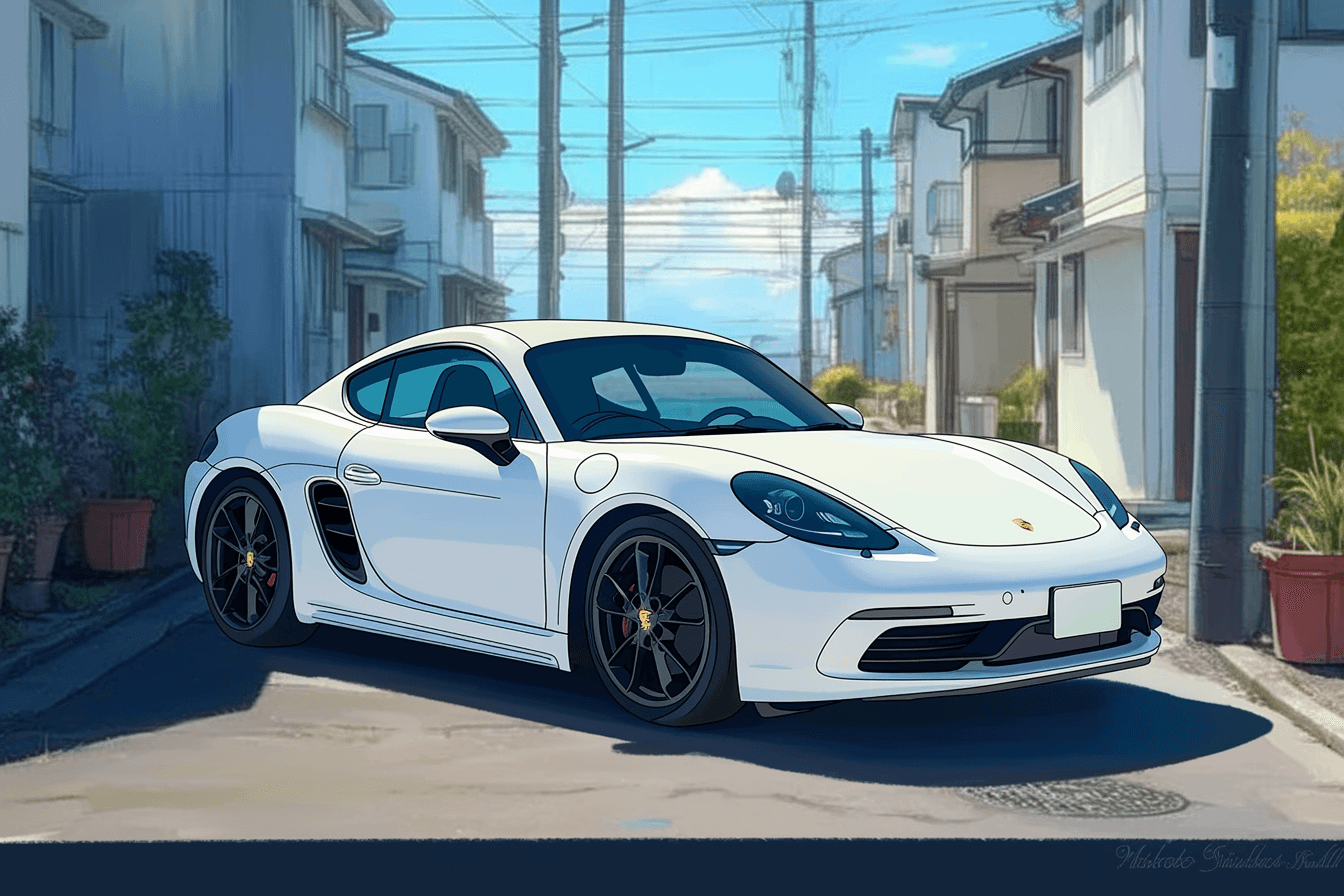
718 Cayman, white, three-quarter front view, on a residential street
00

Overview

Production
2017–2025
Chassis code
982 (marketed as "718")
Layout
Mid-engine, RWD
Engine code
MA2.20
Power
300 hp @ 6,500 rpm
Torque
280 lb-ft (peak RPM cited as ~1,950, unverified against a primary source)
Transmission
6MT or 7-speed PDK
Curb weight
~2,943–3,034 lb depending on transmission

Known-issue mix

  • 1Critical
  • 6Watch
  • 5Clear
01

Known issues

Critical

Multiple safety recalls (build-window specific — confirm via VIN)

These are three distinct recalls, not one — confirm all applicable ones via VIN rather than assuming any single fix covers everything. (1) Fuel collection pipe screws (2017 models, Porsche campaign AH01, began March 27, 2017): screws fastening fuel collection pipes in the engine bay could shear, risking a fuel leak or fire. (2) Luggage compartment bracket/crossmember (2017–2019 718 Cayman and Cayman S, began April 19, 2019): a crossmember could detach from the luggage bracket in a crash, risking a fuel leak or fire; dealers added rivets to secure it. (3) Side airbag impact sensors (2018 718 Cayman, Cayman S, and Cayman GTS, began May 17, 2019): sensors possibly not torqued to spec, risking non-deployment in a crash. All three are corroborated across multiple aggregator sources, though this research pass couldn't retrieve the underlying NHTSA campaign pages directly beyond confirming campaign AH01 by name.

What to check

  • Run the VIN through NHTSA's recall lookup to confirm completion of all three campaigns, if the build date/model year falls in an affected window
  • Don't take a seller's word for it — get documented confirmation of recall completion for each
  • Treat these as non-negotiable safety items regardless of how clean the car is otherwise
Watch

Wastegate actuator rattle / turbo replacement

The turbo's low mounting position exposes the wastegate actuator arm to water and road debris, and corrosion-driven play in the linkage produces a metallic buzzing or rattle. Porsche's fix is full turbo assembly replacement with an updated housing; many cases were reportedly covered under warranty on earlier cars. Most sourcing found for this issue specifically names the base 2.0L's simpler fixed-geometry, internally-wastegated turbo — it's not clearly confirmed whether the S's different variable-turbine-geometry turbo shares the same exposure (see this trim's own known-issues entry for that nuance).

What to check

  • Listen for a metallic buzzing or rattling noise from the engine bay, especially under boost
  • Ask whether the turbo assembly has ever been replaced, and whether it was covered under warranty
Watch

Air-Oil Separator (AOS) failure

Symptoms include white smoke on cold startup, a rough idle, and oil finding its way into the intake tract/throttle body; a failing AOS lets crankcase vacuum run abnormally high. Some specialists recommend proactive replacement on a roughly 6-year/75,000-mile interval regardless of symptoms, since a failed AOS can also contribute to rear main seal issues if left unaddressed.

What to check

  • Cold start the car yourself and watch for smoke or a rough idle
  • Ask about AOS replacement history and mileage/age since the last service
Watch

Coolant reservoir and water pump issues

A failing coolant reservoir shows as a low-coolant warning, a "sweet smell" from the rear of the car, and pink fluid leaks; repair is consistently described as a major job requiring engine removal, though no specific dollar figure turned up in this research pass. Separately, the water pump itself (bearing wear, plastic impeller degradation) and the electronic thermostat (which can fail open) are flagged as recurring weak points. Treat these as two related items worth checking during PPI, not one.

What to check

  • Check for a low-coolant warning light, coolant smell, or visible leaks (especially pink fluid) near the rear of the car
  • Ask about water pump and thermostat service history
  • Confirm the car reaches and holds normal operating temperature during the test drive
Watch

Direct-injection intake valve carbon buildup

Because direct injection sprays fuel straight into the cylinder rather than across the intake valves, there's nothing washing carbon deposits off the back of the valves the way port injection does. One source flags this becoming noticeable somewhere in the 80,000–120,000 km range. The fix is a walnut-blasting service — a few hundred dollars, and not urgent unless it's causing a rough idle or misfire.

What to check

  • Ask about any history of rough idle, hesitation, or misfire
  • Not typically worth a proactive walnut-blast unless symptoms are present
Watch

Headlight/taillight UV coating delamination

Described as a known, carried-over complaint from the 981 generation that Porsche hasn't fully eliminated on the 982. Cosmetic rather than functional in most cases, but worth a visual check, and specialists can address moisture ingress if present.

What to check

  • Visually inspect headlight and taillight housings for cloudiness, delamination, or visible moisture inside the housing
Watch

Wastegate actuator rattle — this trim's specific version of the platform-wide issue

The platform-wide wastegate rattle entry applies to this trim more than any other: the base 2.0L's turbo uses a conventional fixed-geometry, internally-wastegated design that sits low in the chassis, just under the belly pan, directly exposed to water and road debris. The S's larger variable-turbine-geometry (VTG) turbo is mounted higher in the engine bay, away from the elements — a genuine packaging difference, not just a different part. Symptom is a metallic buzz or rattle at idle or light throttle from play in the actuator arm, most concentrated on early (2017-era) cars, that can progress to boost-related issues if ignored. Porsche's official fix is full turbo assembly replacement (later production incorporated a revised, better-protected actuator); an unofficial but widely-reported independent-shop workaround is freeing the actuator with penetrant and re-greasing with high-temp copper grease. No hard failure-rate statistic was found — treat "most common complaint" as forum-consensus framing, not a warranty-data-backed percentage.

What to check

  • Listen for a metallic buzz or rattle from the engine bay at idle or light throttle, especially on 2017-era cars
  • Ask whether the turbo assembly has ever been replaced or serviced for this specific issue
  • Don't assume a clean-sounding car at idle is fully in the clear — the rattle is described as progressive
Clear

IMS bearing — not applicable to this generation

Worth stating explicitly since IMS bearing concerns are usually the first thing buyers researching any water-cooled Porsche ask about. The 982's turbocharged flat-four engines (both the base 2.0L and the S's 2.5L) have no intermediate shaft in the design at all — there's nothing here to fail in that way.

What to check

  • None needed — if a seller or shop tries to sell you an "IMS inspection" on a 718, that's a red flag about them, not the car
Clear

Connecting rod recall — does not apply to turbocharged models

In March/May 2021, Porsche recalled 190 units of the 2021 718 Spyder, Cayman GT4, and Boxster/Cayman GTS 4.0 for connecting rods from an out-of-spec supplier batch that could crack and cause engine damage, stalling, or an oil leak; Porsche replaced engines on affected cars free of charge. This recall is specific to the naturally-aspirated 9A2 4.0L flat-six used in those models — it does not touch the turbocharged 2.0L or 2.5L engines used in the base Cayman and Cayman S. Worth stating explicitly since it's easy to see "718 recall" headlines and assume it applies generation-wide.

What to check

  • None needed for base/S turbo models — if shopping a GTS 4.0, GT4, or Spyder, confirm this recall's completion via VIN instead
Clear

Industrial/gruff idle and low-rev note — a character trait, not a defect

This is one of the most consistent complaints found about the base engine, described variably as gruff, industrial, tappety, or "like a poorly tuned Subaru" at idle and low revs. Edmunds' own trim guide is direct about it, suggesting buyers who prioritize sound skip the turbo-four entirely and step up to the naturally-aspirated GTS 4.0's flat-six. Sport Exhaust (PSE) is the most commonly cited mitigation (see popular options below), though multiple owners note it makes less of a dramatic difference on this generation than it did on the previous naturally-aspirated 981. Worth test-driving with this expectation set rather than assuming a flat-sounding idle points to a mechanical problem.

What to check

  • Listen to the car cold and at idle before judging — this is normal character for the base engine, not a fault to diagnose
  • If sound matters a lot to you, drive a PSE-equipped car specifically before deciding whether the upgrade addresses it enough
Clear

Manual clutch engagement — genuinely stiff, harder to modulate in stop-and-go

Several forum threads describe the manual's clutch as stiff with a high engagement point, making smooth takeoff in stop-and-go traffic harder to feel out than on some other manual sports cars — attributed partly to how and where the turbo engine delivers its low-end torque. This is presented as a driving-character adjustment, not a wear item. Separately, a single isolated forum report described a persistent driveline clunk that reportedly survived a dealer clutch-and-gearbox replacement — worth being aware of, but this is one anecdotal case, not an established pattern, and shouldn't be treated as a documented known issue on its own.

What to check

  • Drive the car in real stop-and-go conditions before buying, not just open road, to judge clutch feel for yourself
  • Listen for any clunk on power on/off transitions during the test drive — not a confirmed pattern, but easy to check for
Clear

Brakes are close to identical to the S — a common assumption gets this wrong

One source claims the base's front rotors are smaller in diameter than the S's (298mm vs. 318mm). A more specifically-sourced pair — a dedicated forum brake-comparison thread plus an OE parts listing — states base and S actually share the same 330mm front / 299mm rear rotor diameter and the same 4-piston fixed calipers front and rear, with the real difference being rotor thickness only (28mm on base vs. 33–34mm on S). This research pass couldn't fully resolve the disagreement against an official Porsche spec sheet, so it's stated here rather than silently picked — but independent instrumented testing (Car and Driver's 70–0 mph test) found the S stopping only 2 feet shorter than base over repeated runs with no fade on either, which is consistent with the "mostly the same hardware" version rather than a meaningfully smaller base brake package.

What to check

  • Don't assume the base car is meaningfully under-braked versus the S — treat brake condition (pad life, rotor wear, fluid age) as the real PPI item, not the trim badge
02

Market pricing context

Typical asking price
$36,000 – $68,000
clean, good-condition examples, manual or PDK

Average sale price is reported around $49,900 (Classic.com aggregate data) — roughly $11,000 below the Cayman S's own average of $60,885 on the same source. A separately-cited, rougher secondhand-market estimate put the base-to-S gap closer to $8,000, which doesn't fully reconcile with the average-to-average comparison above; both are reported here rather than picking one, likely reflecting different sample windows or option mixes. Recorded low and high sales (also Classic.com, via web search rather than a direct page pull): $34,000 for a 2017 model year car (January 2025 sale), and $100,500 for a 2019 model year car (March 2026 sale) — that high figure is unusually elevated for a base trim, closer to well-optioned S/GTS territory, and wasn't independently re-verified against a primary listing, so treat it with real caution rather than as a confirmed record. Refresh periodically rather than treating any of this as live pricing.

As of August 2026 — written market commentary, not live pricing data

Price range

Shaded band = typical range shown above · marker = average sale

$49,942Average
$34,000Record low · 2017 model year, January 7, 2025 sale
$100,500Record high · 2019 model year, March 24, 2026 sale — unusually high for a base trim and not independently re-verified; may reflect a heavily-optioned outlier or a data-categorization quirk
03

Popular options

Sport Exhaust (PSE)

The most frequently recommended option specifically for base buyers — widely described as compensation for the 2.0L's flat, industrial factory idle note. Multiple owners call it worth every penny for the acoustic payoff, but also caution it makes less of a dramatic difference on this generation than it did on the previous naturally-aspirated 981 — set expectations accordingly rather than assuming it fully transforms the sound.

Popular

PASM (Porsche Active Suspension Management)

Broadly recommended for base buyers specifically — owners describe Comfort mode as meaningfully better-riding than the fixed base suspension, with Sport mode still tightening things up when wanted. One long-distance owner reported a comfortable multi-thousand-mile road trip on PASM plus 19-inch wheels.

Popular

PTV (Porsche Torque Vectoring)

More divisive than PASM — some owners find it noticeably helps in fast corners or highway exit ramps, others call it unnecessary for normal street driving and see its real benefit mainly on track or in low-grip conditions. Important bundling detail: PTV cannot be ordered without PASM alongside it (and adds a 10mm lower ride height as a pair), so factor that into pricing a well-optioned base car.

Popular

Sport Chrono Package

Mainly valued on PDK cars for the 0.2s 0-60 gain (via launch control) and the Sport Response button. Less emphasized in base-specific buying discussion than PASM or PSE, but nothing found suggests it's discouraged on base cars either.

Popular

19-inch wheels

Base comes standard on 18-inch wheels (235/45R18 front, 265/45R18 rear); the S more commonly runs 19s. Upgrading is a genuine visual and stance differentiator from a stock base car, and is also a prerequisite for some aftermarket big-brake upgrades that need the extra wheel diameter for caliper clearance.

Popular

6-speed manual transmission

Used-market manual premium is estimated around 5–15% depending on year and spec, driven by low manual take-rate (roughly 10% industry-wide) — this pricing-premium pattern is described platform-wide in the sourcing found, with nothing suggesting it differs meaningfully for base versus S specifically.

Popular

A genuinely unresolved, active debate in owner communities worth knowing about before you shop: whether a well-optioned base car (PASM + PTV + Sport Chrono + a mechanical LSD — essentially replicating a Cayman T's spec) delivers S-level street enjoyment for meaningfully less money, or whether the S is categorically preferable regardless of how the base is optioned, mainly for resale value and usable torque. Both positions show up repeatedly in forum discussion with no clear resolution — treat it as a genuine judgment call based on your own priorities, not a settled question this site can answer for you.

04

Buying checklist

Documents to request

  • Full service history — independent Porsche specialist or OPC (official Porsche Centre) records preferred over generic shop records
  • VIN-based recall confirmation from Porsche/NHTSA — fuel collection pipe screws (AH01), luggage bracket/crossmember, and side airbag sensor recalls, as applicable to build date
  • Title history / accident or salvage check (Carfax or equivalent)

Questions for the seller

  • Have all applicable recalls been completed — fuel pipe screws, luggage bracket, and side airbag sensors, depending on model year?
  • Any history of a rattling or buzzing noise from the engine bay, especially under boost?
  • Any coolant warning lights, smells, or visible leaks near the rear of the car?
  • Has the AOS (air-oil separator) ever been replaced, and at what mileage?
  • Has the turbo/wastegate actuator ever rattled, and if so, was it addressed with a turbo replacement or a workaround?
  • What size wheels does this car have — factory 18-inch, or upgraded 19s or larger?

PPI advice

  • Confirm no IMS bearing concern applies — this generation's turbo engines have no intermediate shaft; don't pay for an "IMS inspection" upsell
  • Cold start the car yourself and listen for a rattle from the turbo/wastegate area, and watch for smoke indicating AOS wear
  • Check the cooling system thoroughly, including the coolant reservoir and water pump
  • Confirm all applicable safety recalls (fuel pipe screws, luggage bracket, airbag sensors) via VIN — treat as non-negotiable
  • Use a shop that specializes in Porsche, ideally with specific 982/718 experience
  • Listen closely at idle and light throttle for the wastegate actuator rattle common on this trim's turbo
  • Test the manual clutch in real stop-and-go traffic, not just open-road driving, if manual-equipped